A Simple System for Sorting Household Paper
Create a paper routine that separates documents by what they need from you, gives important records a sensible home, and makes retrieval easier without relying on a particular filing product.
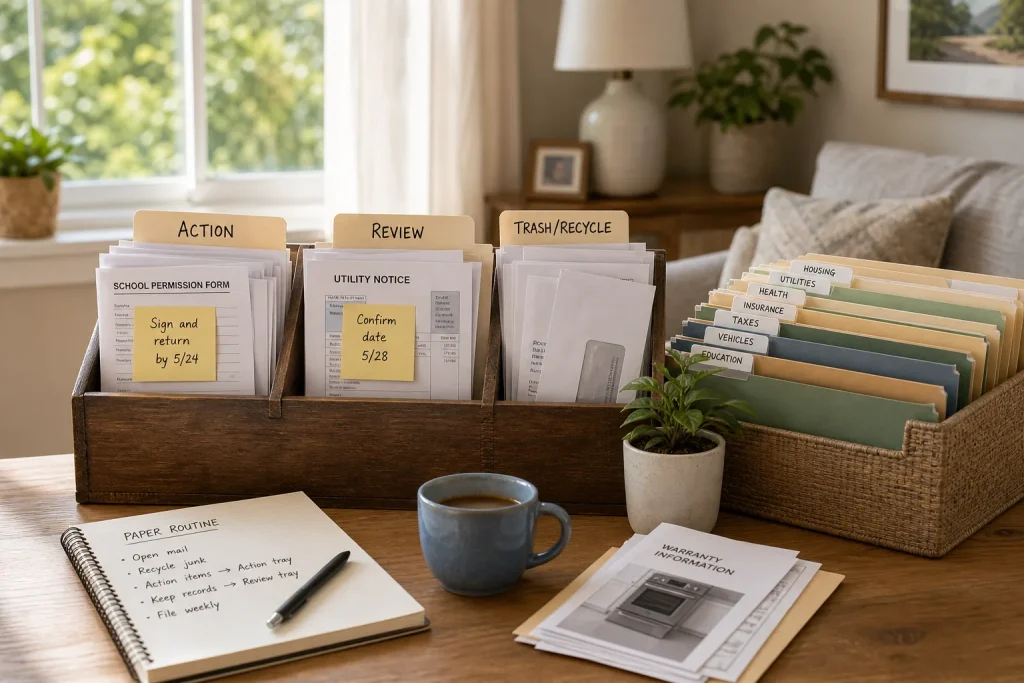
Household paper becomes difficult to manage when every envelope, notice, receipt, and form lands in the same pile. The solution is not necessarily a more elaborate filing product. It is a small sequence of decisions: identify what arrived, decide whether it needs action, and put it somewhere you can find again. A useful system reflects how you actually handle bills, school forms, medical records, warranties, and other documents rather than forcing every page into one category.
Start with a clear sorting area and a few broad destinations. You can use folders, boxes, trays, or a drawer; the labels and habits matter more than the container. Keep the routine simple enough to repeat when you are busy. If a document’s status is visible and its eventual home is predictable, paper is less likely to become an increasingly mysterious stack.
Separate incoming paper by what happens next
When paper arrives, first identify its next purpose. A document may require an action, need to be kept for reference, or be ready to discard. These are more useful first choices than filing by sender, because they answer the immediate question: what should happen to this page? Create a visible place for items awaiting action, a separate holding area for records to sort, and a way to dispose of paper that no longer serves a purpose.
Handle each item once when practical, but do not force a decision you cannot yet make. If you need to confirm a date or discuss a form with someone, place it in the action area and note the next step. Keep that area distinct from permanent records so an urgent notice does not disappear among old statements. When several people share the household, make the labels understandable to everyone who may need to act.
Make the action area specific and visible
“To do” is a useful start, but a page with no visible next step can linger there. Add a short note such as “sign and return,” “check the appointment date,” or “call the provider.” If timing matters, record the relevant date on the document or on a reminder you already use. The purpose is not to build a second complex tracking system; it is to make the needed action obvious when you review the papers.
Choose a regular moment to look through pending items, perhaps when handling household mail or reviewing the week ahead. During that review, complete a task, set a reminder, or move the paper to its longer-term home. If an item depends on someone else, make that dependency visible rather than silently returning it to the pile. For sensitive or consequential paperwork, use common sense about privacy and ask an appropriate professional when you are unsure what must be retained or submitted.
Keep reference records in broad, familiar groups
Once an item no longer needs immediate action, decide whether it is useful to retain. Group records under labels that match ordinary household questions: housing, utilities, health, education, insurance, vehicles, or taxes. These categories are starting points, not rules. If you rarely need a category, combine it with a broader one; if you often search for a particular kind of record, give it a clearer label. Avoid creating so many subdivisions that filing becomes a separate project.
Keep related papers together when that makes them easier to retrieve. A notice and its response, for instance, may make more sense as one small set than as pages filed under unrelated labels. Store private documents in a location appropriate to their sensitivity, and distinguish originals or records that may have special handling requirements. For decisions about legal, financial, or medical retention, rely on qualified guidance relevant to your situation rather than assuming every household needs the same rule.
Choose storage around your actual retrieval habits
There is no single required filing product. A folder in a drawer, a labeled box, a binder, or another accessible arrangement can work if it protects the papers and supports quick retrieval. Decide where the system should live by considering who needs access, how much space is available, and whether documents must be kept away from children, visitors, moisture, or other household risks. Put the action area somewhere easy to notice; keep long-term records where they can remain orderly.
Use labels that you would naturally search for, not labels that sound formal but mean little to you. If you are unsure where an item belongs, choose a broad category and add a brief note rather than inventing a new section on the spot. Revisit the arrangement when you repeatedly search in the wrong place or hesitate over the same kind of document. A small adjustment to a label can be more useful than replacing the whole system.
Build a short sorting and retrieval habit
Give new paper a predictable route from arrival to its destination. You might open mail near the sorting area, recycle obvious junk, move action items into view, and place records to keep in a temporary holding spot until you file them. The routine can be brief, but it should happen often enough that action items remain visible and paper does not accumulate beyond what you can comfortably review. Pick a rhythm that fits the household rather than an ideal schedule you are unlikely to maintain.
Retrieval is part of the system, not an occasional test of memory. When you look for a document, notice which label or location you expected to find it under. If the search was awkward, update the category or return the item promptly after use. Shared households can agree on one simple rule: anyone who removes a paper either returns it to its labeled home or leaves a clear note about where it went. That makes the arrangement understandable beyond the person who first sorted it.
Work through one hypothetical household example
Hypothetical worked example: Imagine a household receives a school permission form, a utility notice, and a warranty leaflet in the same week. The form needs a signature before it can be returned, the notice contains a date to check, and the leaflet may help if an appliance needs service later. The household has limited drawer space and does not want a specialized filing product. These constraints call for a visible action area and a compact set of familiar reference folders.
They place the permission form in the action area with “sign and return” written beside the due date, and put the utility notice there with “confirm date” as its next step. After checking the notice, they move it into their utilities folder if it remains useful. They place the warranty leaflet with household appliance records and recycle it later if it no longer applies. The expected result is that pending tasks stay distinct from reference papers, while the household accepts a tradeoff: broad folders may take a moment longer to search than finely divided ones, but they are easier to maintain.
Conclusion: Let the routine do the organizing
A workable paper system depends on consistent destinations and clear next actions, not a perfect set of folders. Sort incoming pages into action, reference, or disposal; make pending work visible; and keep retained documents in broad groups that match the questions you are likely to ask. Choose storage that suits your space, privacy needs, and household access rather than buying a product before you understand the routine.
Start with the paper already in front of you and establish only the categories you need. As you use the system, let real searches guide small changes to labels and locations. A brief, repeatable review can keep documents findable without turning household paperwork into a major organizing project.