Packing for a Trip Without Planning for Every Possibility
Choose clothes and essentials around your itinerary, realistic laundry access and likely conditions—not a suitcase full of imagined emergencies.
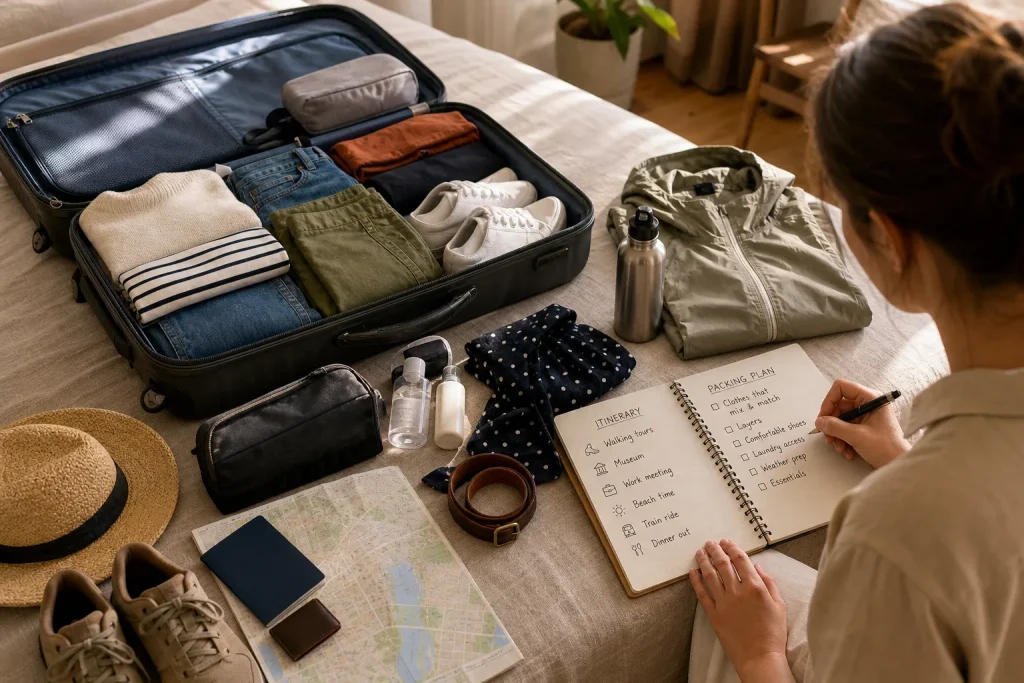
Packing can turn an ordinary trip into a parade of hypothetical problems: What if every day is colder than expected? What if an outfit gets stained? What if an invitation calls for something formal? Preparing for the trip you are taking is more useful than trying to cover every possible version of it. Start with the activities already on the itinerary, the conditions you can reasonably anticipate and the options available along the way. Then choose a small set of items that work together and leave room to adapt. The aim is not to pack as little as possible; it is to make deliberate choices instead of treating uncertainty as a reason to bring everything.
Start with the itinerary, not the suitcase
List the activities that are genuinely part of the trip: walking between museums, a work meeting, time at the beach, or a long train ride. For each, consider what the activity calls for in comfort, coverage and formality. A city break built around walking suggests comfortable shoes and clothes that remain pleasant through a full day. A dinner reservation may call for one polished outfit, not a different set of formal clothes for every evening. This keeps packing tied to what you plan to do rather than to a vague image of what might happen.
Separate confirmed plans from possibilities you would merely like to keep open. If an outdoor excursion is booked, pack for it; if you are only wondering whether you might go hiking, consider whether ordinary walking clothes could serve instead. Think about how often an item can be used and whether it pairs with other pieces. A layer that works on a travel day and over an evening outfit earns its place more readily than a single-purpose garment for an uncertain plan. The result is a bag shaped by the trip’s real demands, with flexibility built in.
Choose a workable clothing system
Rather than assigning a unique outfit to each day, select a coordinated group of tops, bottoms and layers. Keep colors or patterns compatible enough that pieces can be recombined, while allowing for the trip’s setting and your own preferences. Prioritize clothes that suit the expected activities and feel comfortable for extended wear. Shoes deserve particular attention: a pair that supports the main itinerary is often more useful than several options packed to address imagined changes in mood. If a specific occasion requires different footwear, decide whether it is certain enough to justify the space.
Balance repeating clothes against carrying extras. A shirt that can be worn more than once may be sensible if the days are not especially demanding and suitable laundry is accessible. For activities involving heat, rain or mess, a spare may matter more. Avoid packing an entire backup wardrobe; identify the particular item that would be inconvenient to lack and plan for that need. One versatile outer layer, for example, can be more helpful than several pieces chosen for mutually exclusive forecasts. The right mix depends on the itinerary, not on an abstract rule about how many garments to bring.
Let laundry access shape the plan
Check the actual laundry options before relying on them: whether your accommodation has a usable machine, whether a laundromat is nearby and open when you could visit, or whether hand-washing a small item is permitted and practical. Do not assume that every garment is suitable for hand-washing; follow its care label, and skip that option if the fabric, available facilities or your circumstances make it unsuitable. Consider time, drying arrangements and the effort involved. If washing is unlikely to fit the schedule, pack enough of the items you prefer to change regularly. If convenient laundry is genuinely available, reusing suitable pieces may be practical.
Make the choice about effort as well as access. Someone arriving late and changing accommodations often may reasonably prefer extra basics to a laundry task. A traveler staying in one place with an open afternoon may welcome a wash, provided there is a suitable machine or an appropriate way to clean and dry the items. Distinguish between clothes that can comfortably be reworn and those you prefer to change after a particular activity. Laundry should support the plan, not become an obligation that disrupts it. Check accommodation details rather than assuming a listing or a sink will meet your needs.
Pack for likely conditions and sensible contingencies
Use the forecast and the destination’s typical conditions as guidance, while recognizing that forecasts can shift. For likely rain, a compact waterproof layer may be more practical than several extra outfits. For cool evenings, a warm layer that works with daytime clothes can cover a change in temperature without requiring a separate ensemble. Think about what weather would change in your activities: rain may call for shoes that handle wet pavements, while a sunny day may make shade and sun protection more relevant. Choose specific responses to plausible conditions rather than packing for every imaginable one.
Prepare for small disruptions without trying to anticipate every emergency. Keep travel documents and device accessories you need accessible. If you take medication, plan according to your own needs and relevant travel requirements; consult a qualified health professional or pharmacist about questions involving prescriptions, storage or travel across borders. For ordinary problems, ask whether a local shop, accommodation staff or a change of plan offers a reasonable alternative. A spare layer addresses a likely temperature shift; multiple outfits for a hypothetical chain of mishaps may not. Carry what would be difficult to do without and leave manageable problems room for ordinary solutions.
Use one decision rule for uncertain items
When an item remains in doubt, ask three questions: Is it connected to a planned activity or likely condition? Can another item already in the bag serve the same purpose? Would it be difficult or unpleasant to obtain or improvise at the destination? An item with a clear role and no reasonable substitute has a strong case. Something that answers only a remote possibility, duplicates another item and is easy to find later is a weaker choice. This is not a rigid formula; it is a way to make uncertainty concrete enough to decide.
Then consider the cost of carrying it. A bulky item can make travel less comfortable even if it might prove useful, while a small essential may be worth bringing despite uncertain use. If two pieces serve similar roles, choose the one that works with more of the planned wardrobe or supports more than one activity. Leave room for a purchase or souvenir if that matters to you, rather than filling every gap before departure. The point is to make space for the trip itself, not to turn the bag into a warehouse of possible solutions.
Worked example: a changeable city weekend
Consider an invented, hypothetical traveler planning a city weekend with museum visits, substantial walking and one booked dinner. The forecast suggests mild days with a chance of rain. The accommodation description confirms a shared machine, but its use would take time the traveler does not expect to have; no convenient laundromat has been identified. The traveler starts with a walking outfit, a dinner outfit and a small set of compatible tops and bottoms. They check the care labels before considering hand-washing and decide not to depend on it, since suitable facilities and drying time are uncertain.
Next, the traveler adds comfortable walking shoes, a light rain layer, a warmer evening layer, documents, a device cable and medication needed for their individual routine. They leave out a second pair of formal shoes and clothing for unplanned events. The resulting decision is to pack enough preferred changes for the planned activities and treat laundry as unavailable, rather than allowing an uncertain facility to determine the wardrobe. If the forecast turns wet, the rain layer offers a response; if plans change, the traveler accepts that the packed clothes may not suit every possible occasion. Another traveler with confirmed laundry access or a booked outdoor event could reasonably choose differently.
Conclusion: pack for the trip you can describe
A useful packing plan begins with what is known: where you will go, what you intend to do, what conditions are plausible and whether laundry is genuinely available at a convenient time. Build a coordinated clothing group around those details, then add essentials that would be difficult to manage without. Give uncertain items a role-based review rather than letting every imagined problem claim space. This method allows for reasonable contingencies without requiring a perfect prediction of the trip.
Before closing the bag, picture the itinerary and match each planned activity to something you have packed. Check that likely weather has a practical response, that laundry assumptions fit both garment care and your schedule, and that important personal essentials are included. If an item has no clear connection to those needs, consider leaving it behind. A little uncertainty is part of travel; packing thoughtfully means deciding which uncertainty deserves preparation and which can remain an ordinary part of the day.