Why Everyday Objects Become Symbols of Belonging
A mug, recipe card, or repaired jacket can carry a shared history—but its meaning depends on who recognizes it, where it appears, and how it is treated.
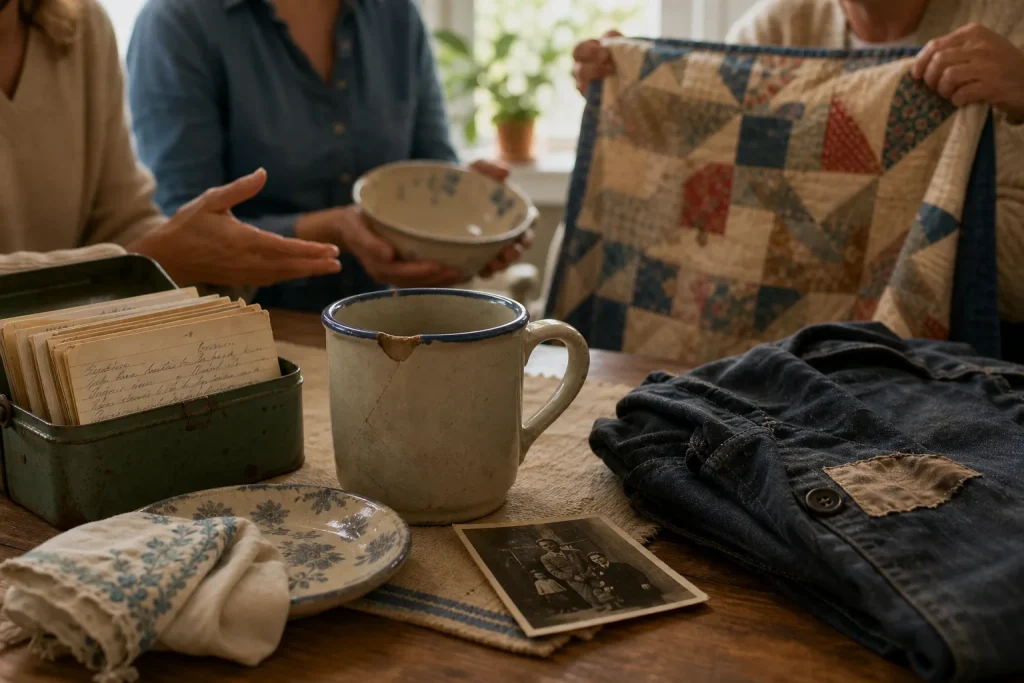
A chipped mug may be an ordinary kitchen item to one person and a family keepsake to another. Its importance can come from who used it, the routines around it, or stories told when it appears. But an object does not carry one meaning for everyone who encounters it. A symbol that feels familiar to one person may seem private, neutral, or uncomfortable to someone else. Even people with a shared background can disagree about what an object represents. Understanding its role means noticing who owns it, who knows its story, and whether the people connected to it want that story shared.
Objects gather meaning through repeated use
Many objects become significant through ordinary routines rather than a deliberate decision to make them special. A mixing bowl might return for family meals; a coat might pass from one relative to another; a bench might become a regular place for neighbors to pause. Repetition links an object with particular people and occasions. Seeing it may bring those associations to mind, though the memories it evokes can differ among those who were present.
Practical care can become part of an object’s history. A repaired handle or a worn recipe card may reflect a choice to keep using something, but wear alone does not prove affection or importance. An old item might be cherished, overlooked, or discarded, depending on its history and its owner’s feelings. Rather than reading age or damage as a complete story, it is more careful to ask what the item means to the person who keeps it.
Recognition depends on shared knowledge
A familiar pattern, emblem, or serving dish may prompt recognition among people who know its particular associations. That recognition can open a conversation: someone asks about the object, and its owner chooses whether to explain it. The connection does not reside in the object by itself. It takes shape through the knowledge, memories, and relationships of the people who recognize or discuss it.
That knowledge is rarely universal, even within a family or community. A newcomer may see a decoration without knowing its history, while someone else connects it to a specific occasion. Explaining the context can invite conversation, but expecting everyone to recognize a symbol can make it feel like a test. If an object is presented as a sign of belonging, consider whether its meaning is being shared openly or treated as knowledge that only insiders should have.
Setting changes what an object communicates
An object can be understood differently at home, at a gathering, or in a shop. A hand-stitched cloth might be everyday tableware in one setting and a focus of conversation in another. What viewers notice depends partly on how the object is used, where it is placed, and what they already know. The item has not changed, but its surroundings shape the questions people ask and the assumptions they may make.
Permission and privacy are part of that context. A garment used in a ceremony may not be suitable as a casual display piece, and a family photograph shared among relatives may not be meant for public circulation. Before displaying an object as a symbol, find out who owns it, whether they agree to the proposed use, and whether the new setting respects its original purpose. If those details are uncertain, pause rather than treating a meaningful-looking object as available.
Appearance cannot tell the whole story
It is tempting to infer a history from an object’s appearance: age might suggest inheritance, handwork might suggest a family connection, or a design might seem to point to a particular community. Those impressions can be wrong. Similar objects may have unrelated histories, and people who share a background may have different responses to the same design. Asking an owner what an item means is more respectful than assigning it a story based on looks.
Ownership does not automatically create attachment, either. Someone may inherit an object without wanting to keep it, while another person may value an everyday item because it recalls a friend or chosen family. There is no single correct way to preserve a connection. A story, recipe, or recurring practice may carry a memory without requiring someone to keep a particular possession. Letting an object go does not, by itself, establish what a person feels about the people or history associated with it.
Careful conversation leaves room for difference
When an object is part of a gathering, a brief explanation can help people understand how it is used and why it matters to its owner. Make clear whether visitors may touch or photograph it, especially if it is fragile, private, or connected to a practice that has particular rules. Invite questions without expecting anyone to teach a lesson or disclose more than they wish. These small choices keep the conversation grounded in the owner’s preferences rather than in assumptions about what an object should mean.
People connected to the same object may disagree about its history or significance. One relative might find an ornament comforting, while another associates it with a difficult period. Acknowledging both accounts can make room for a fuller conversation without forcing a single interpretation. If the object is to be displayed or handled, those involved can discuss what feels acceptable. When agreement is not possible, leaving it private may be more considerate than presenting it as a shared symbol.
Decide what to share by checking ownership and context
Before using an object to represent a family or community, identify its owner, ask permission for the specific use, and check whether its history is known. Then consider the setting: does the proposed display fit the object’s purpose, and can visitors understand the context without being expected to guess? If answers are unclear, choose a different item or explain the uncertainty. These questions do not settle what an object means; they help avoid presenting one person’s interpretation as everyone’s view.
Hypothetical worked example: Imagine an organizer planning a neighborhood gathering. The hypothetical starting information is that a resident made a quilt for private family use, while the organizer knows only that it came from a nearby household. First, the organizer asks that resident whether the quilt may be displayed. The resident says it is not available for public use, so the organizer removes it from the plan. Next, the organizer asks whether the resident has an alternative intended for community events. The resident offers a different fabric piece and explains its purpose. The resulting choice is to display only the item the resident has agreed to share, with its context explained. The tradeoff is a revised plan rather than using a familiar-looking object without permission.
Conclusion: Belonging rests in relationships
Everyday objects can prompt memories, mark routines, or start conversations, but their meanings are not uniform. They are shaped by the people who own, use, remember, and encounter them, as well as by where and how they appear. An object’s appearance cannot establish its history, and no single item should be assumed to speak for everyone connected to it.
Approach unfamiliar objects with curiosity rather than certainty. Ask the people connected to an item what they want shared, respect their answer, and leave space for differing interpretations. When ownership, context, and consent guide the conversation, an object can offer a point of connection without being asked to represent more than its owner intends.